Acclaim
Review
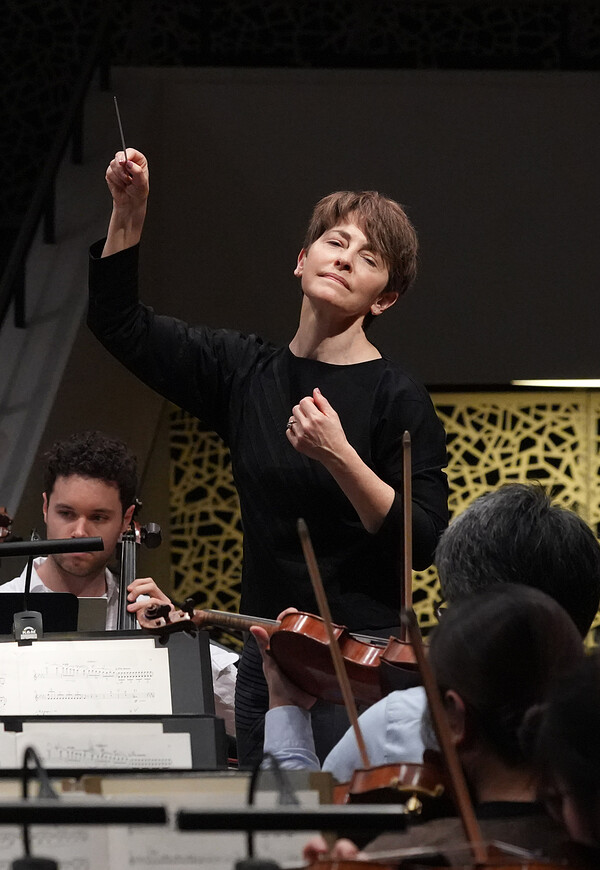
Koblenz. Striking music composed by three young men in the early 20th century resonated during the eighth subscription concert of the Koblenz Music Institute: Sergei Prokofiev and George Gershwin created the evening’s first two works while in their mid-twenties, while the final piece was written by 19-year-old Dmitri Shostakovich as his graduation project. Guest conductor Laura Jackson took the podium to lead the Rhineland Philharmonic in Koblenz.
The American conductor is a bundle of energy with a keen sense for incisive accents—a quality evident right from the start. With sharp, precise beats, she guides the orchestra into the territory required for Prokofiev’s "Classical Symphony," particularly in its outer movements: a high-speed dance played out on a floor of "classical" borrowings—evoking the spiritedness of Mozart and Haydn—interwoven with Prokofiev’s own mischievous touches.
That sounds simpler than it actually is—after all, the performance must run like a "well-oiled machine," much like a theatrical comedy production. There is a profusion of shifts in tempo, rhythm, and motifs; transitions from the steps of an elegant minuet to the heavier-footed gavotte; and melodic hand-offs—ranging from fluid to tempestuous—between instrumental registers, all accompanied by the sly, audacious touches characteristic of Prokofiev. The "well-oiled" Rhine-based orchestra delivers a performance that is a sheer, almost spring-like delight.
This served as excellent preparation for the orchestra to tackle Gershwin’s Concerto in F, a work demanding numerous rapid—and sometimes radical—shifts in rhythm, dynamics, tempo, melody, and atmosphere, as well as close interplay with the soloist. With American conductor Jackson on the podium, American pianist Claire Huangci at the keyboard, and a work originally titled "New York Concerto" by one of America’s most significant composers, the program could hardly be more quintessentially American. The orchestra from the confluence of the Rhine and Mosel rises to the challenge, displaying a jazz sensibility that is, for the most part, brilliantly realized.
The Symphony No. 1 in F minor, composed by Shostakovich in 1924–25 with astonishing maturity, confirmed his early reputation as a genius. While clothed in a form that remains classical, the work already contains numerous elements of the modernity that would come to characterize his oeuvre. The performance in Koblenz finely brings out the rebellious, witty interjections, the ironic undercurrents or exaggerations, and the multifaceted play with then-novel tone colors.
Amidst this perpetual interplay of self-doubt, melancholy, and impassioned high drama, moments of light are rare and fleeting. It is here, too, that other facets of Laura Jackson’s impactful conducting style become apparent: whenever the score calls for triumphant pathos or *furioso* intensity, she throws her entire body into the effort with unbridled energy, using sweeping gestures to drive the orchestra—which follows her expertly—to the very brink of unbridled bombast. Because the young composer resorted to this device repeatedly, the audience is left uncertain after the final outburst whether more is to come—before, after a brief pause, erupting into thunderous applause.